Specifying Private Label Titanium Drinkware: A Buyer's Checklist
Nine decisions that decide whether a private label order arrives as specified — wall thickness, logo method, packaging and the golden sample.
Start with a reference, not a description
A brief that says "a premium titanium mug, about 350 ml" will produce five different samples from five suppliers, and none of them will be what the buyer pictured. A brief that includes one physical reference — an existing product, a competitor sample, or a 3D file with dimensions — removes most of the ambiguity in one step.
Send the reference together with the end use: retail shelf, gift box, hotel amenity, or promotional order. The end use decides the finish, the packaging and the inspection standard, and it is the detail suppliers most often have to guess.
Decide capacity and tolerance
Capacity should be stated as a nominal figure plus an acceptable range, because a deep-drawn vessel stretches and the final volume depends on the wall thickness achieved. A 350 ml mug that holds 340 ml is not a defect; a 350 ml mug that holds 300 ml is.
Ask the supplier to confirm where capacity is measured to — the brim, or a comfortable fill level below it. Retail copy usually quotes the brim figure, which is optimistic, and customers notice.
Pin down wall thickness and weight
Wall thickness drives three things at once: weight, rigidity and cost. Titanium is strong, but a very thin wall dents under a dropped bag and transmits heat to the hand faster.
State the target weight in grams, not just the thickness in millimetres. Weight is the number a customer can verify with a kitchen scale, and it is the number that shows up in a product listing. Then ask for the thickness tolerance the factory will hold.
Choose the finish in the sample stage
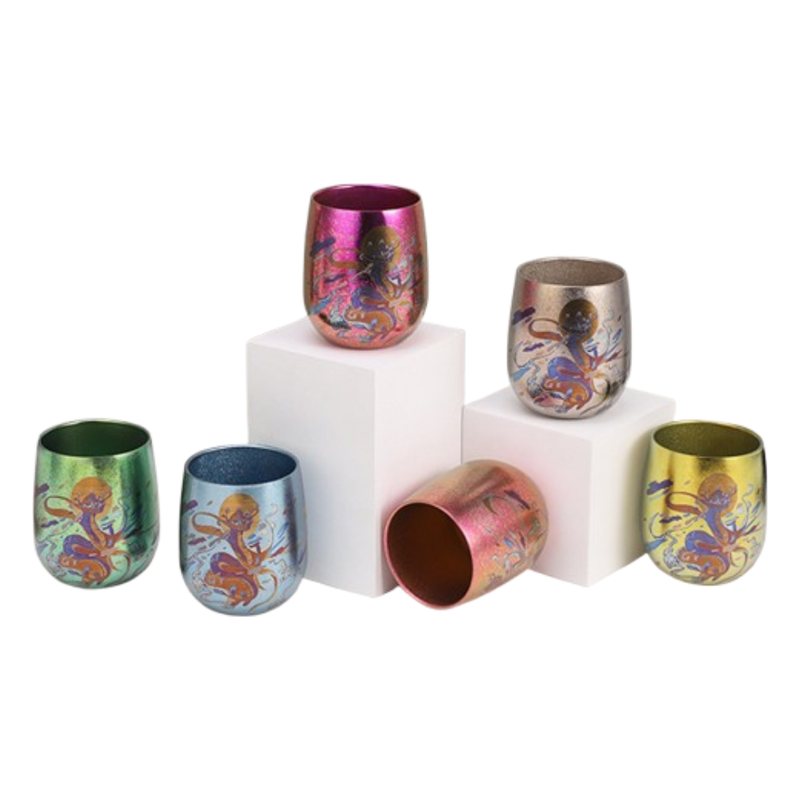
Standard options are polished, brushed or satin, sandblasted, and anodised colour. Each behaves differently in use: polished shows fingerprints, brushed hides small scratches, sandblasted grips, anodised colour adds a premium line but is a thin oxide film rather than a coating.
Ask for finish samples on the actual production shape. A brushed finish that looks right on a flat plaque can look uneven around a drawn curve.
Pick the logo method deliberately
| Method | How it looks | Wears | Best for |
|---|---|---|---|
| Laser engraving | Matte, light grey mark cut into the metal | Permanent, cannot rub off | Logos with fine detail, permanent brand marks |
| Pad printing | Opaque ink in any spot colour | Can wear at edges with heavy use | Colour logos, small runs, low tooling cost |
| Anodised mask | Logo appears in a second colour of oxide | Permanent, same film as the body | Two-tone premium designs |
| Etching | Shallow recessed mark, subtle | Permanent | Discreet branding, tactile finish |
Laser engraving is the default for titanium because it needs no consumables and never fades. Pad printing is cheaper to set up and lets you print in a brand colour, but the ink sits on the surface and will eventually scuff on a product that is handled daily.
Packaging decides the unboxing
A titanium mug in a plain poly bag and the same mug in a printed box with a moulded insert are two different products at two different price points. Specify the box material, print method, insert, and whether a hangtag or care card is included.
If the product is going to a marketplace, ask for the packaging to be drop-tested in the configuration you will actually ship, not in a factory carton that never reaches the customer.
Documents you should receive
- Mill certificate or material test report showing the titanium grade.
- Food-contact test report from a recognised laboratory, valid for the destination market.
- Inspection report with the sample size and the defects found.
- Packing list with carton dimensions, gross weight and quantity per carton.
If a supplier cannot produce the first two, the conversation is about price rather than specification, and it should be treated that way. Our quality inspection page lists what we check on every run.
Approve a golden sample and photograph it
The golden sample is the physical piece both sides agree is correct: colour, weight, logo position, box print. Sign it, date it, and photograph it next to a ruler under neutral light.
The photograph matters more than the signature. Signatures get separated from the sample; a dated photo in the order file settles most arguments about "the logo was always that low" before they start.
Fix the schedule and the terms
Confirm the production lead time from deposit, not from enquiry, and state the inspection point: before packing, or after. Agree the Incoterm — FOB, CIF or EXW — and who books the freight, because a quotation that looks 8% cheaper often excludes the forwarder charges that the buyer then pays directly.
Five mistakes that show up again and again
- Approving a sample that was made by hand in a sample room rather than on the production line.
- Specifying a colour from a screen, then rejecting the batch against that screen.
- Leaving the logo position to the factory's standard placement.
- Forgetting to specify the inner packaging, then discovering the retail box does not fit the carton. See also our sourcing notes from Yongkang.
- Ordering the first run at the minimum quantity and the second at three times that, without confirming the price break applies.
Frequently asked questions
What is a typical minimum order for private label titanium drinkware?
Minimums depend on the shape and the logo method rather than on titanium itself. Laser engraving has no tooling, so minimums are usually set by the production run; a new drawn shape requires tooling and therefore a larger first order. Ask for both numbers separately.
Can I mix colours in one order?
Usually yes, within the same shape. Colour changes require separate anodising batches, so mixed-colour orders are quoted per colour and take slightly longer to schedule.
Who owns the tooling I pay for?
This must be stated in writing. The common arrangement is that the buyer pays for tooling and owns it, with the mould held at the factory for future orders. Get the clause in the purchase order rather than in an email.
Tivarol Editorial
Written in Yongkang, Zhejiang. Tivarol supplies pure titanium tableware and outdoor cookware to retailers, hospitality groups and brands, with OEM and private label production. Figures quoted in this article are general material properties — for a specific item, ask for the specification sheet and test reports.